The highest-stakes contest on the planet
We're already playing Climate Chess. We just don't know it yet.
Climate change isn't a puzzle waiting to be solved. It's a contest being played right now, between two teams, on a constantly evolving board. Team Climate No-Urgency has been outpacing Team Climate Urgency for decades. Here's why, and what it would actually take to change that.
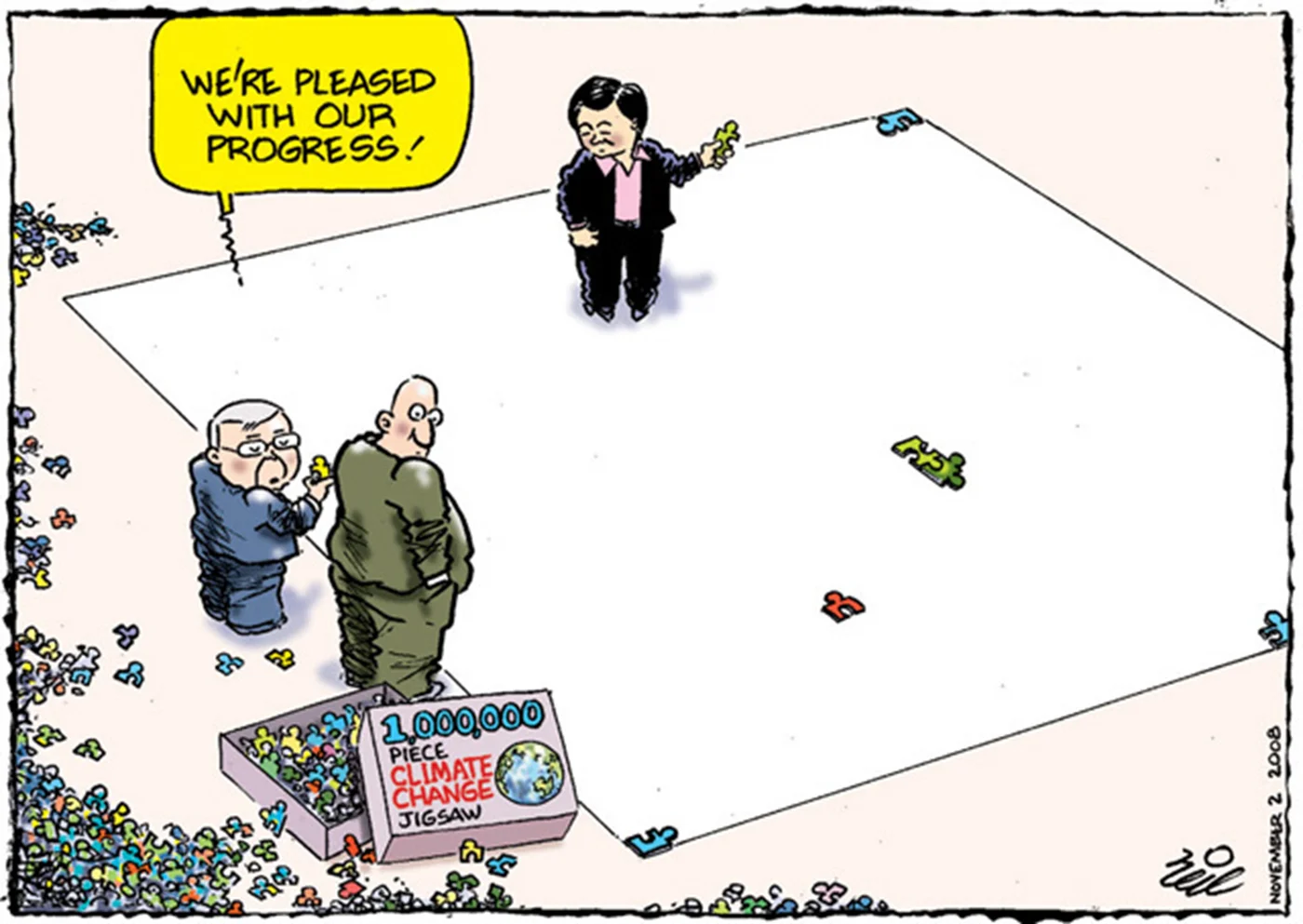
Why not a puzzle?
We used to describe climate change as a jigsaw puzzle. That was the wrong comparison.
For years, the go-to metaphor for climate change was a million-piece jigsaw puzzle, with the world's decision-makers slowly, steadily fitting pieces into place. It's a comforting picture: keep enough people working long enough, and the picture eventually completes itself, the same way a thousand chimpanzees at a thousand typewriters will, given enough time, eventually produce Shakespeare.
But climate change isn't that kind of problem. A jigsaw puzzle has no opponent. Nobody is scattering the pieces, hiding the box lid, or convincing the table the picture doesn't really need finishing. Climate change does have that opponent: an organized, well-resourced one that benefits every year the picture stays unfinished. That's what makes this a contest, not a puzzle, and why patience alone was never going to be a strategy.
"Insanity: doing the same thing over and over again and expecting different results."
Attributed to Einstein (he probably didn't say it, but it's a great line)
Why we need a new frame
Climate change is a wicked problem. Our brains aren't built for those.
Global emissions are now roughly five times higher than when scientists first raised the alarm some 60 years ago. Average global temperature has already risen more than 1°C, a shift that, in Earth's history, has tracked with roughly 60 feet of sea level change. Hundreds of international meetings, national policies, and voluntary corporate pledges later, we're still not close to sufficiently bending the curve. That's not because nobody's trying. It's because we've been bringing the wrong tools to a wicked problem.
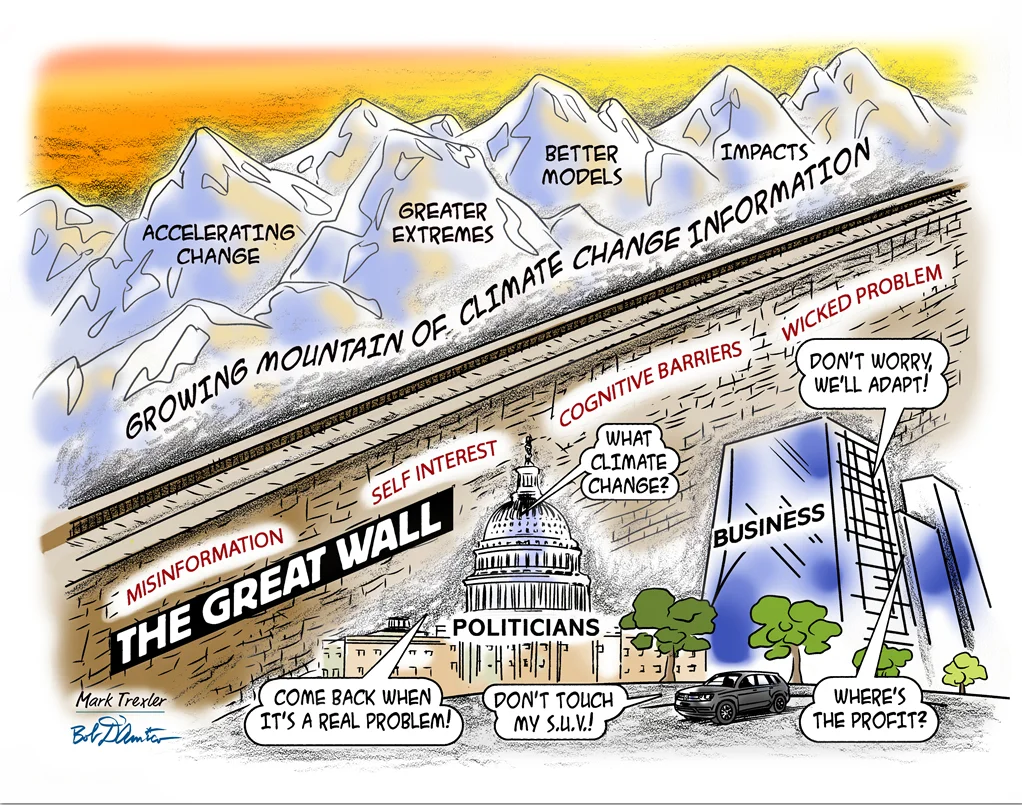
Who's actually playing
Two teams. One wildly stacked board.
For better or worse, almost everyone with a stake in climate change is playing Climate Chess, whether they realize it or not, as part of one of two teams.
Team No-Urgency
When not questioning the science or materiality of climate change, Team No-Urgency argues the near-term costs of rapidly restructuring the global energy system outweigh the discounted future costs of climate impacts, and that innovation and adaptability will manage what does happen.
Team Urgency
Rooted in trust in climate science and a risk-averse view of societal welfare, Team Urgency argues human and economic adaptability have real physical limits, and that delay compounds the damage faster than we can adapt to it.
The uncomfortable truth
Team No-Urgency has been winning for decades
Not just because defense is easier than offense, though it is. Team No-Urgency has also simply been the more disciplined, better-coordinated side. Team Urgency, meanwhile, has repeatedly re-enacted the Charge of the Light Brigade: brave, individually righteous, and strategically uncoordinated, throwing itself at entrenched positions again and again with the same result.
The real problem isn't a shortage of players
Team Urgency has plenty of pieces. It just doesn't play like a team.
Hundreds of Team Urgency chess pieces are already on the board: policies, technologies, lawsuits, divestment campaigns, communications efforts. But in most cases they're operating on their own, competing with each other for attention and funding rather than pulling together, unlike the coordinated moves being made by Team No-Urgency.

"Our risk brains are still searching for lions in the Serengeti."
On why humans are so bad at perceiving slow-moving, systemic risk
A winning strategy
What Team Urgency actually needs: a nerve center
More than 100 million people in the U.S. alone are alarmed or concerned about climate change. But we largely leave it up to each individual to figure out how to best influence climate outcomes, when the reality is that almost no one has any idea how they individually can help. That's not a motivation problem. It's a coordination problem, and it's solvable with the same tools already used to win elections and campaigns, aimed instead at moving the pieces that matter most, at the moments that matter most. Here's what a Team Urgency nerve center would do.
Sign people up to Team Urgency
There's plenty of information to make climate change matter to almost anyone, whether the hook is local impacts, job impacts, security impacts, or something else entirely. The right message, matched to the right person, is what turns concern into engagement.
Build each person's Team Urgency profile
Match individuals to the roles that fit their skills, resources, and willingness to act, whether that's lobbying, funding, organizing, writing, or simply showing up. The goal is a strategy that actually uses what people bring to the table.
Continuously match people to the best moves, in real time
Identify and prioritize the highest-value opportunities to move Team Urgency's pieces forward, then point the right people to the right opportunity at the right moment, keeping them motivated instead of overwhelmed.
It's been done before
Just not for this
Large-scale data analytics, behavioral modeling, and targeted engagement aren't hypothetical; they've already reshaped U.S. elections. Climate Chess proposes using the same category of tools for a different purpose: helping tens of millions of already-concerned people find their most useful role in tackling climate change, not manipulating them into one.
Where things stand
The website is the easy part.
In the prior sections we've created an attractive website to introduce the concept of Climate Chess. But it's time to worry less about the aesthetics of the website than the importance of the message. For better or worse, while Team No-Urgency clearly exists, it's not clear that Team Urgency does. While there are hundreds of potential Team Urgency chess pieces on the board, there is no systematic effort to coordinate how those pieces are advanced on the board, much less coordinated efforts to interfere with the moves of Team No-Urgency. Each Team Urgency piece has its own individual or organization trying to characterize it as "the solution," or as one of a few critical pieces, instead of looking holistically at the chessboard to figure out which pieces stand the best chance of being advanced at any given time, if only they had the necessary resources and support, in the interests of bringing about systemic change. Organizations and individuals are treating climate change as a jigsaw puzzle, not a chessboard. Until key climate advocates step up to create a Team Urgency nerve center, Team No-Urgency will continue to win at Climate Chess!
The Climatographers
How the Climatographers Can Help
The Climatographers have been tackling climate change since 1988, when founder Dr. Mark C. Trexler joined the World Resources Institute's nascent Climate, Energy, and Pollution Program. The Climatographers subsequently founded the first U.S. business climate risk consultancy in 1991, and have been at the cutting edge of climate risk analysis and management ever since. They started characterizing climate change as a "Climate Chess" challenge almost 15 years ago, and have been promoting the need for Team Urgency to organize and compete more effectively ever since, including through the Team Urgency nerve center described above. They have thought extensively about the nature of the Climate Chess contest, the topography of the Climate Chessboard, and the strengths and weaknesses of each team. Their knowledge solutions, including the Climate Web and Climate Notebooks, contain much of the information a Team Urgency nerve center would need. If you're intrigued by the idea of Climate Chess, and want to help make Climate Chess a real, coordinated option for climate progress, or just want to think out loud about what a Team Urgency nerve center could look like, the Climatographers would like to hear from you. You can reach out to mark@climatographer.com.